
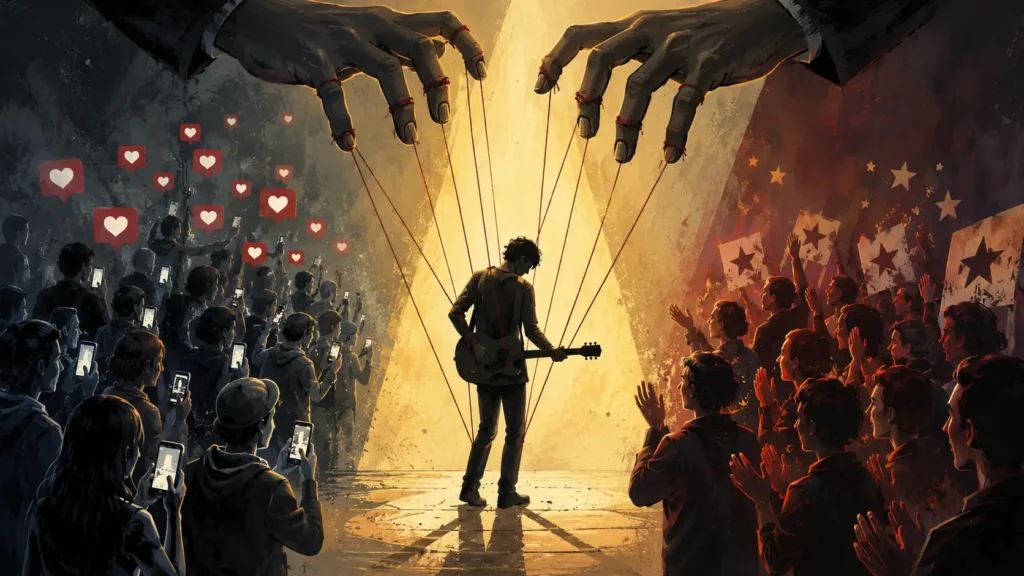
The Word We Throw Like a Stone
“Sellout” is one of those accusations that carries an unusual emotional weight. It is rarely used casually. When people say it, they usually mean it as a moral judgement, not simply a criticism of quality or direction. The word implies betrayal. Corruption. A collapse of integrity in exchange for money, status, comfort, or survival.
In art and politics especially, the accusation appears constantly. A musician signs to a major label. A rebellious filmmaker starts making safer blockbusters. A radical public figure softens their position after gaining influence. An underground creator suddenly begins speaking the polished language of branding and marketability.
Almost immediately, somebody says it:
“They sold out.”
But the more I think about the phrase, the stranger it becomes. What actually counts as selling out? Who decides when it has happened? Is it something an artist consciously chooses, or something that quietly emerges over time without them even noticing? And perhaps most importantly, are audiences always correct when they accuse someone of it?
The more closely you examine the concept, the less stable it becomes.
Integrity According to Who?
One of the strange things about accusations of selling out is that integrity is often treated as something externally granted.
An audience discovers an artist and emotionally connects with them. The artist represents something. Authenticity. Rebellion. Honesty. Rawness. A shared worldview. Over time, the audience begins to feel ownership over that connection. Not necessarily in a malicious way, but emotionally.
Then the artist changes.
Maybe the sound changes. Maybe the politics soften. Maybe the work becomes more accessible. Maybe the artist simply grows older and no longer feels driven by the same emotional fuel they once did.
Suddenly the audience declares that the integrity is gone.
But this raises an uncomfortable question. If integrity is internal, how can it be externally revoked?
What if the artist genuinely believes in the new direction? What if the change is sincere? What if abandoning the old style was actually the more honest thing to do?
Audiences often confuse familiarity with authenticity. They mistake consistency for integrity because consistency is comforting. It allows the relationship between creator and audience to remain stable. Predictable. Safe.
But real human beings do not remain static forever. Genuine growth often creates contradiction. Sometimes the person who wrote one album, one book, or one manifesto simply no longer exists in the same form years later.
At that point, what exactly are audiences demanding loyalty to? The artist’s truth, or the audience’s memory of it?
The Passive Sellout
We usually imagine selling out as an active process.
An artist changes their work specifically to gain money, status, or broader appeal. The rebellion becomes marketable. The edges are sanded down. The dangerous ideas are replaced with safer ones.
But I think there is another form of selling out that people talk about far less often.
The passive sellout.
This happens when an artist continues producing work they no longer truly believe in because it is safe. Because it maintains their audience. Because it protects their career. Because it keeps the machine running smoothly.
In many ways, this form may be even harder to detect because externally nothing appears to have changed at all.
The audience is still happy. The branding remains intact. The familiar emotional experience continues to be delivered on schedule. Everybody applauds the artist for “staying true to themselves.”
But are they?
If an artist privately feels disconnected from their own work yet continues reproducing it because it guarantees stability, then what exactly is being preserved? Integrity, or inertia?
There is a strange irony here. Artists who genuinely evolve are often accused of selling out, while artists who endlessly repeat themselves are praised for consistency, even if that consistency has become emotionally hollow.
Growth gets punished. Repetition gets rewarded.
Not necessarily because repetition creates better art, but because repetition is easier for people to emotionally rely on.
The Audience’s Responsibility
Artists are constantly expected to evolve without alienating their audience. But audiences are rarely expected to evolve alongside the artist.
This creates an impossible balancing act.
People often say they want artists to grow, but what they usually mean is that they want carefully managed growth that still preserves the emotional relationship they originally formed with the work. They want evolution without discomfort. Change without loss.
But genuine artistic growth does not always feel comfortable. Sometimes it challenges the audience directly. Sometimes it abandons the very thing people originally loved.
At that point, accusations of selling out can become emotionally confused.
Sometimes what audiences call “selling out” is simply an artist refusing to remain a mirror for someone else’s identity.
Fans often build parts of themselves around art. Music, films, books, and political figures become emotional landmarks in people’s lives. When those things change, it can feel strangely personal. The audience experiences grief, disappointment, or even betrayal.
And to be fair, sometimes the audience is correct. Sometimes artists genuinely do compromise themselves for money or status.
But not always.
Sometimes the accusation simply means:
“You stopped reflecting the version of me that I was comfortable with.”
The Reality of Survival
There is also another uncomfortable truth hidden beneath all of this.
Most people compromise.
People work jobs they dislike. They soften opinions around employers. They tolerate systems they disagree with because rent exists. Food exists. Survival exists. Very few human beings live in complete alignment with their ideals at all times.
The difference with public figures is visibility.
When ordinary people compromise, it is mostly hidden inside private life. When artists or celebrities compromise, the entire world watches it happen in public.
This creates a strange moral distortion where celebrities become symbolic battlegrounds for ideas about authenticity and corruption. People project enormous expectations onto them, demanding levels of ideological purity that most ordinary people could never realistically sustain themselves.
That does not mean all compromise is meaningless or beyond criticism. It simply means the situation is often more human and complicated than the word “sellout” allows.
Sometimes people change because they are greedy. Sometimes they change because they are exhausted. Sometimes they change because they finally escaped poverty. Sometimes they stay exactly the same because they are terrified of losing relevance. And sometimes they genuinely evolve into different people.
Reality rarely fits neatly into a single accusatory word.
The Fear Beneath the Accusation
I suspect that part of the emotional power of the word “sellout” comes from fear.
Not just fear that artists will betray us, but fear that integrity itself may be far more fragile than we would like to believe.
Because if survival, comfort, recognition, and social pressure can slowly reshape artists and public figures, then perhaps they can reshape anyone.
Perhaps they already do.
Maybe the reason accusations of selling out feel so emotionally charged is because they force us to confront the uncomfortable possibility that compromise is not some rare corruption that happens only to celebrities and politicians. It may simply be part of being human inside systems powerful enough to reward conformity and punish instability.
The difference is that some people do it under a spotlight while the rest of us do it quietly.
And perhaps that is why the conversation never truly goes away.