
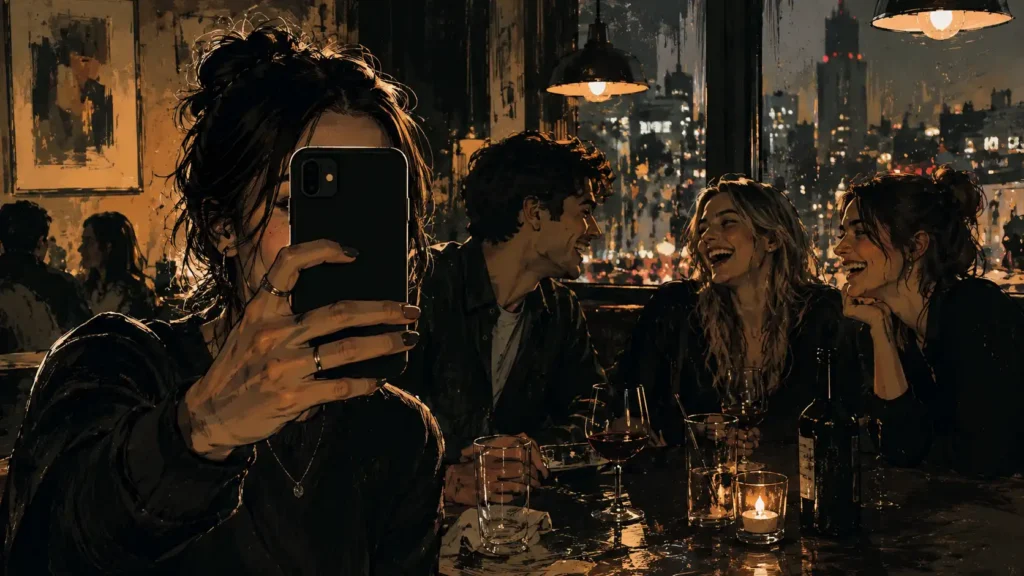
When I was younger, we just called it taking a photo. Photographs were not rare exactly, but they usually felt intentional. Cameras were separate objects that had to be carried around deliberately, and film itself cost money. Taking a photograph often meant that something had stood out enough to deserve preservation. A birthday, a holiday, a friend, a strange moment, a family gathering that nobody realised at the time would later become historically important to the people in it.
The photograph existed primarily as memory. A fragment of time rescued from disappearance.
Today, photography has become something else entirely. Not necessarily worse, but undeniably different.
The Camera and the Audience
Most people now carry a high quality camera everywhere they go. More importantly, they also carry an audience. This changes the psychological function of photography in subtle but profound ways. A photograph is no longer simply an attempt to preserve a memory for yourself. It can also become a way of communicating something outwardly to other people.
“I was here.”
“I experienced this.”
“This is who I am.”
“This is what my life looks like.”
Social media transformed photographs from private memory objects into public social signals. Images now communicate status, identity, activity, belonging, attractiveness, humour, morality, taste, politics and lifestyle. A photograph is no longer just a picture. It is often a statement, whether consciously intended that way or not.
The Performance of Experience
I do not think this shift is entirely fake or cynical. Human beings have always performed aspects of themselves socially. Clothing, speech, fashion, posture and status symbols have existed for as long as civilisation itself. But technology has intensified and accelerated the process dramatically.
Experiences are now frequently shaped around their own documentation. Restaurants are designed to be photographed. Holidays are selected partly for visual appeal. Nights out become opportunities for content generation as much as social connection. Entire environments are built around recognisable aesthetics and visual signalling.
Sometimes it feels as though people are no longer simply having experiences. They are curating evidence of having experiences.
The strange irony is that the act of documentation itself can begin to interrupt presence. A moment becomes psychologically split in two. Part of the mind remains inside the experience itself, while another part steps outside of it and begins evaluating it from the perspective of an imagined audience.
How will this look?
Is this worth posting?
Which angle is best?
Which version of this moment is most shareable?
The Moments Nobody Photographs
Some of the most meaningful moments of my life have no photographic evidence whatsoever. Long conversations late at night. Moments of vulnerability between friends. Shared grief. Shared laughter so absurd that language itself began collapsing. Tiny interactions that permanently altered my understanding of somebody.
None of these moments needed a camera to validate them. In fact, many of them would probably have been weakened by one.
There is something psychologically revealing about this. The deeper and more emotionally authentic a moment becomes, the less likely people often are to interrupt it for documentation. Presence itself takes priority over proof.
Yet social media creates an environment where visibility and value slowly begin to merge together in the public consciousness. Experiences that are not posted can begin to feel socially invisible, and what is invisible is often culturally mistaken for unimportant.
Memory Versus Marketing
This is where the question becomes uncomfortable.
What exactly are we preserving when we take a selfie?
Sometimes the answer really is memory. Sometimes people are documenting joy, friendship, beauty or personal growth in entirely sincere ways. There is absolutely nothing inherently shallow about wanting to preserve a moment of your life. Old photographs become priceless with time. They outlive people. They preserve faces, places and emotions that would otherwise disappear forever.
But social media introduces another layer entirely. A photograph can quietly become a form of personal marketing. Not necessarily in a manipulative sense. Often this process is almost subconscious. People gradually learn that visibility has social value. To appear active, social, attractive, successful or happy carries real psychological and sometimes even economic advantages in modern society.
As a result, photographs increasingly stop asking “What do I want to remember?” and begin asking “What do I want other people to believe about my life?”
What Is a Selfie Worth?
The answer depends entirely on why it was taken.
A selfie can be narcissistic. A selfie can be sentimental. A selfie can be insecurity disguised as confidence. A selfie can be self expression. A selfie can preserve the final photograph ever taken between two friends before one of them dies. A selfie can also be a performance directed towards an invisible audience.
The technology itself is neutral. What matters is the relationship we develop with it.
I do not believe selfies are destroying society, nor do I think people should stop documenting their lives. Human beings have always tried to preserve themselves against the erosion of time.
But I do think it is worth occasionally asking ourselves a difficult question.
Are we documenting our lives?
Or are we gradually learning to perform them?