
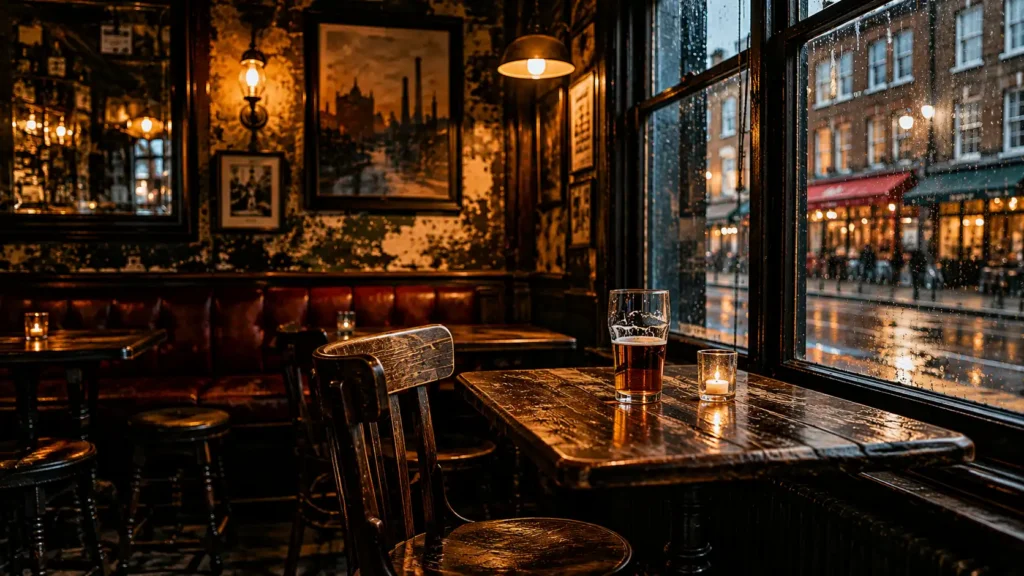
If I am paying money to spend time somewhere, I expect two basic things.
A seat.
And the ability to hear what my friends are saying.
That is not luxury. It is not elitism. It is not a demand for perfection. It is the bare minimum required for a social environment to fulfil its purpose. Yet increasingly, especially in cities, these basic expectations feel strangely difficult to meet.
You walk into a pub or café and every table is packed so tightly together that you are effectively sharing personal space with strangers. Music is blasted at a volume that makes sustained conversation exhausting. Seating is sparse, uncomfortable, or deliberately limited. Sometimes there are technically enough seats, but the atmosphere itself discourages settling. Everything subtly pushes you towards movement.
Consume. Circulate. Leave.
The more I observe this pattern, the more I realise something uncomfortable.
Many modern spaces do not actually want us to stay.
A Seat Is Permission to Exist
A chair is not just furniture.
A comfortable place to sit communicates something psychologically important: you are allowed to be here. You are allowed to settle. To pause. To occupy space without justification.
The absence of seating creates the opposite feeling. You become temporary. Conditional. You are tolerated only so long as you continue participating in the intended flow of movement and spending.
This is especially noticeable in cities, where physical space is financially valuable and human presence increasingly feels transactional. Businesses optimise for turnover. More people moving through a space means more opportunities for sales. Comfort slows that process down.
A person who settles deeply into a space might buy one drink and stay for hours talking to friends.
A constantly rotating crowd spends more.
From a business perspective, this logic makes sense. But from a human perspective, something important is lost.
We are no longer being hosted.
Our wallets are.
The Architecture of Discomfort
Not all discomfort is accidental.
Sometimes it is subtle. Loud music. Hard chairs. Tiny tables. Awkward spacing. Environments that make deep conversation difficult and prolonged stillness slightly irritating.
Sometimes it is explicit.
Cities around the world have become infamous for manifestations of hostile architecture. Benches divided by metal bars to prevent lying down. Anti homeless spikes. Public spaces intentionally designed to discourage lingering.
People often treat these examples as separate from the design of pubs, cafés, shopping centres, or other commercial environments. I am not convinced they are entirely separate phenomena.
The scale and intent may differ, but the underlying message feels strangely similar:
Do not settle here.
Keep moving.
Performance Instead of Presence
There is another side to this phenomenon.
Despite these environments often being deeply unpleasant for actual conversation, many people still actively seek them out. Why?
Part of the answer is obvious. Some people simply enjoy high energy spaces. Some people have a higher tolerance for sensory chaos than others. Alcohol also changes the equation significantly.
But I suspect there is another layer too.
Modern social life has become increasingly performative.
Social media rewards the appearance of activity, excitement, popularity, movement. A crowded bar with neon lights and loud music photographs better than two people quietly talking in a dim corner booth for three hours.
The irony is that the most meaningful social interactions often leave the least documentary evidence behind.
The best conversations of my life were not interrupted for selfies.
In many cases, the people having the deepest and most authentic interactions are too busy actually being present to curate proof that they were there.
The Value of Stillness
One of my favourite pubs in London is Quinns.
It sits close to Camden, one of the loudest and most overstimulating areas in the city, yet somehow remains calm. Spacious. Unhurried. You can usually sit down. You can hear people speak. You can simply exist there without feeling pressure to perform energy back at the room.
That should not feel rare.
And yet increasingly, it does.
Places like this remind me that human beings are not machines built purely for circulation and consumption. We need spaces where we are allowed to pause without guilt. Spaces where conversation can unfold naturally. Spaces where comfort is not treated as inefficiency.
Because ultimately, the quality of a social environment is not measured by how loudly it announces itself.
It is measured by whether people can genuinely connect inside it.
And perhaps one of the clearest signs that a place respects your humanity is surprisingly simple:
It lets you sit down and stay a while.