
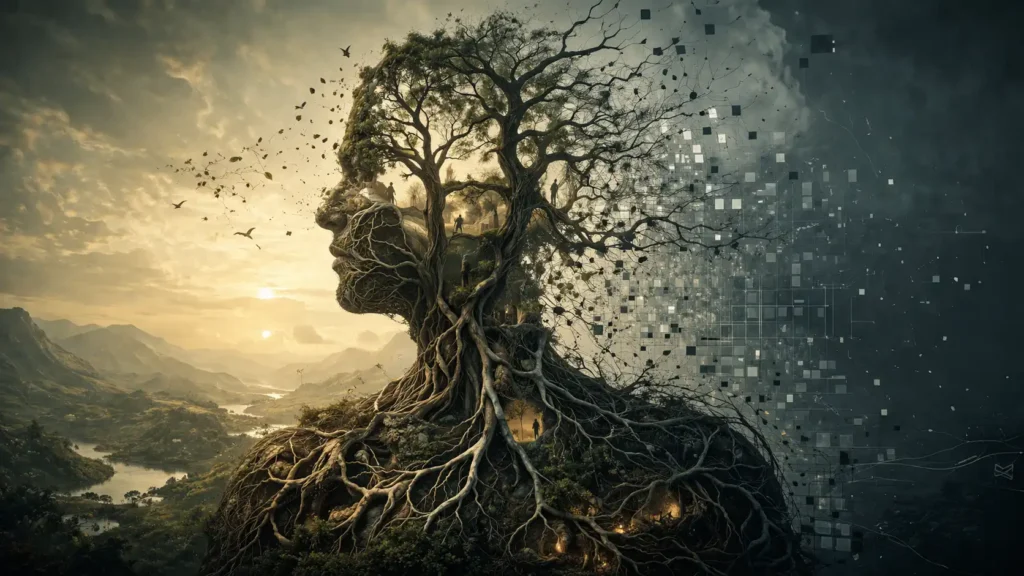
The Collapse of Surface Identity
There was a time when identity felt anchored.
If you saw someone’s face, heard their voice, or watched them move through the world, there was an implicit assumption that you were encountering the person themselves. The surface was trusted as evidence.
That assumption is dissolving.
AI can now generate faces that never existed, voices that never spoke, and artwork that appears intentional and emotionally charged. The surface layer of identity has become reproducible. It can be generated, modified, and deployed without the person it resembles ever being present.
So the question shifts.
If the surface can be copied, what actually belongs to us?
The Copyable Self
AI has become highly effective at reproducing the elements we once relied on to recognise a person.
It can simulate visual likeness, vocal tone, stylistic patterns, and even behavioural tendencies. These were once treated as proof of identity. Now they are patterns that can be learned and replayed.
This is not a distant possibility. It is already happening in subtle ways across creative tools, media production, and everyday digital interactions.
You can now generate something that looks like a photograph, sounds like a person, or resembles a piece of art, without any of those things ever existing in reality.
At this level, identity begins to look less like a fixed truth and more like a set of reproducible signals.
A Moment That Cannot Be Generated
At one point in my life, I took LSD with a friend.
At some stage during the experience, they spiralled into a full bad trip. Their perception of reality became unstable, and they lost their sense of control. It was not random. It was tied to something that had happened earlier in their life. Something unresolved that surfaced when their usual defences dropped away.
I was in the same altered state. Not sober. Not grounded. But I had to become the stable one.
I found myself monitoring them closely, trying to keep them safe while my own perception of reality was shifting underneath me. It required focus, restraint, and a kind of responsibility that cut through the distortion of the experience.
Then something happened.
A thunderstorm rolled in. A real one. It was later confirmed by others. It was loud, constant, and dramatic, with lightning cutting through the sky for hours.
It changed everything.
The fear broke. The tension dissolved. It felt as though something external had entered the situation and restructured it entirely.
We went outside and stood in the rain. The storm carried on around us, and what had just been panic became something calm and connected. The moment carried a sense of meaning that is difficult to reduce into language.
That experience stayed with me.
Not as an image or an idea, but as something lived.
The Depth Behind the Moment
What made that moment meaningful was not just what happened, but everything that led to it.
My friend’s reaction was shaped by their past. My response was shaped by my own capacity to act under pressure. The storm was an external event that neither of us controlled, yet it became integrated into the experience in a way that transformed it.
This was not a sequence of events. It was the intersection of multiple timelines.
AI can generate a storm. It can generate a distressed figure. It can even construct something that resembles a moment of emotional resolution.
What it cannot generate is the continuity that gives those elements their weight. It cannot recreate the specific past that caused the reaction, the responsibility taken in that moment, or the way the experience is carried forward afterwards.
Meaning did not exist in the visuals alone. It emerged from the relationship between past, present, and perception.
Art From a Living System
I am a music producer and a writer of fiction and poetry.
Across all of it, my work comes from the same place. It draws from an internal well shaped by my experiences, my values, and the way I have processed the world over time.
When I create something, it is rarely a case of deciding to make something impressive or interesting and then attempting to execute that idea. More often, I am responding to something internal that already exists and is seeking expression.
The work is a byproduct of that process.
It is not primarily a performance for others, and it is not dependent on external validation. In many cases, I am indifferent to how it is received, because its origin is internal rather than external.
AI can assist in this process. It can help shape an idea or provide a means of expressing it more effectively. There is no conflict in acknowledging that.
However, it does not generate the conditions that make expression necessary.
Those conditions come from a life. From accumulation, contradiction, and the gradual formation of a perspective that cannot be reduced to a single output.
The Illusion of Meaning
AI-generated work can appear meaningful because it draws from patterns associated with meaning.
It can reflect emotional structures, familiar aesthetics, and symbolic language. It can produce something that feels coherent and intentional.
But there is a difference between something that represents meaning and something that emerges from it.
AI operates in the first category. It can simulate the appearance of depth, but it does not have anything at stake. It does not carry the weight of experience into the work it produces.
Human expression is often dense because it compresses lived experience into a form that can be shared. That density is not easily replicated by assembling patterns alone.
Timeline as Identity
If your face can be copied, your voice replicated, and your style imitated, what remains is your timeline.
Not a public record or a curated version of events, but the continuity of experience that only you have lived.
The fact that you were present for specific moments, that you felt them, and that they shaped you in ways that persist.
That continuity cannot be extracted or reproduced. It can be described or approximated, but it cannot be lived from the inside by anything else.
This is where identity resides when surface signals become unreliable.
A Boundary That Still Holds
This is not an argument against AI.
AI is a powerful tool. It can assist, accelerate, and expand what is possible within creative and technical fields.
But it does not replace the origin of meaning.
It does not generate a life, and it does not carry experience through time.
You can copy my face. You can copy my voice. You can approximate my style.
But you cannot copy the sequence of moments that made me.
And without that, you are not copying me.
You are copying the outline.
It makes the line between the external and internal blurrier as well as the line around individuality.