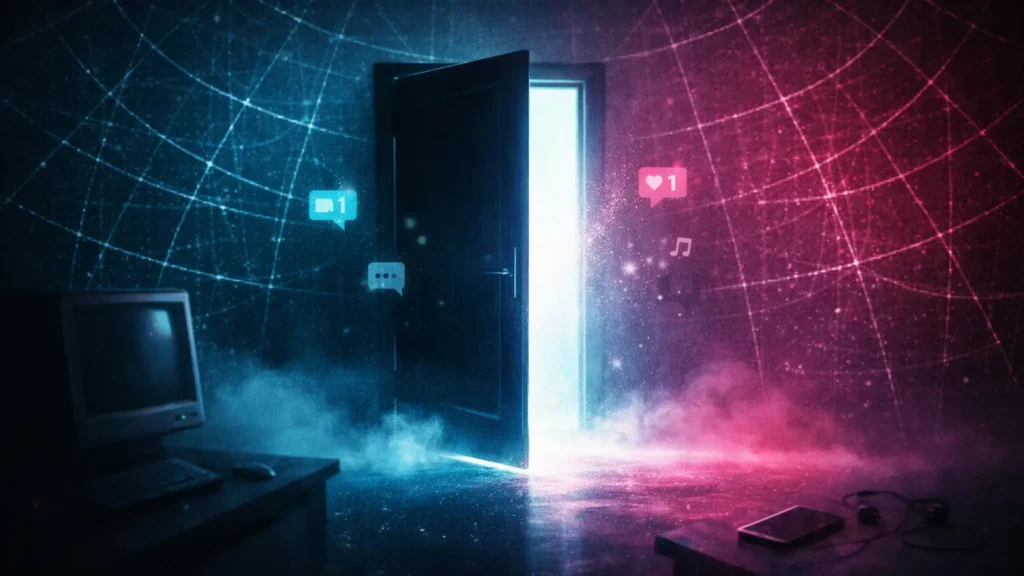
Why I Don’t Use Social Media is a three-part series exploring my relationship with online connection, how social networking slowly became social media, and why I eventually stepped away. This isn’t a rage-quit or a moral sermon. It’s simply an honest account of what changed, what was lost, and what I gained in the quiet.
For years now, I’ve watched the same social media ritual play out again and again.
Someone decides they’ve had enough. Social media is making them miserable, exhausting them, dragging them into drama, or pulling them into patterns that don’t feel healthy anymore. They write a long post explaining why they’re leaving, disable their accounts, and disappear.
Then, sooner or later, they come back.
Sometimes they quietly reactivate their old profile. Sometimes they make a new one and call it a fresh start. Sometimes they re-emerge without comment, as if nothing ever happened. It’s such a familiar pattern that it’s become a cultural joke.
I’m not judging those people. I understand it. Social media can genuinely damage your wellbeing, and sometimes a dramatic exit is the only way someone can break out of a cycle that feels addictive or emotionally chaotic.
But the reason I’ve titled this series Why I Don’t Use Social Media is partly because it echoes that familiar pattern in a slightly post-ironic way. The difference is that my truth isn’t that pattern at all.
I didn’t rage-quit. I didn’t announce my departure. I didn’t even delete my accounts.
I simply stopped logging on.
The Quiet Exit
If you ask most people what it means to “leave social media”, they picture something dramatic. Deleting apps. Deactivating accounts. Making a statement. Cutting people off. A digital detox that looks like a breakup.
For me, it wasn’t like that. I didn’t burn anything down, and I didn’t even choose a symbolic “last post”. I just stopped feeding it. I stopped posting. I stopped checking. I stopped scrolling. I unsubscribed from notifications, and stopped treating the feed like it had any claim on my attention.
At first, it didn’t feel like much. There was no cinematic moment of liberation. It was simply quieter, and then quieter again. The social urgency began to fade, and the pressure to keep up, stay visible, react, and maintain presence slowly lost its grip.
Feeds Aren’t Friendships
One of the strangest things about stepping away from social media is what it reveals about relationships.
A feed can create the illusion of connection. You know what people are doing, what they’re thinking, who they’re dating, what they ate, what they’re outraged about this week, what they’re celebrating, and what version of themselves they’re presenting. Even if you haven’t spoken to someone directly in months or years, the steady drip of updates can make it feel like they’re still part of your life.
But once you stop logging on, you realise how much of that closeness was simulated.
A lot of what we call “friendship” online is really just passive proximity. It’s not a relationship, it’s a feed. It’s information that creates the sensation of connection without the substance of it.
When that stream disappears, you see who still exists in your life outside the platform. The people that matter still show up. The people that matter still message you. The people that matter still tell you what’s going on, directly, in their own words, without filtering it through a public performance.
I don’t need to see what people are up to on a feed. The people that matter, tell me in person.
Connection vs Performance
Social media doesn’t only host social life. It trains it. The longer you stay in it, the more it reshapes your instincts about what social contact is supposed to look like.
It starts out as communication, but over time it becomes presence management. You’re not just living, you’re maintaining visibility. You’re not just sharing, you’re curating. Even if you’re not actively posting, you’re still living under the logic of an invisible audience.
There’s a psychological weight that comes with being constantly “seen”, or at least constantly available to be seen. For me, that weight never felt natural. It felt like a constant demand to be interpretable, presentable, and legible in a way that real life doesn’t require.
And this is the trap. Being seen is not the same thing as being known.
Logging off was the first time in years I realised how much of my social energy wasn’t being spent on relationships. It was being spent on being visible to the feed.
What I Gained (And What I Lost)
To be fair, stepping away from social media does come with trade-offs. You miss updates. You find out things later than everyone else. You lose that effortless sense of being “in the loop”. Sometimes you realise entire social circles now exist almost entirely inside an app, and if you’re not there, you are quietly absent.
Honestly, one of the biggest practical benefits I’ve lost is the news feed on releases and gigs from my favourite artists. Social media is very good at keeping you informed, especially in music scenes where things can be underground or informal.
But even that loss hasn’t been a disaster. In a strange way, it’s reclaimed some intentionality. Instead of being told that something exists, often framed as urgent, limited, and time-sensitive, I now tend to stumble upon a new release when I’m actively looking an artist up. It turns buying music back into something deliberate rather than reactive.
The same applies to events. Rather than being trapped in a constant churn of one-off nights that must be attended, I look up what’s on as and when I actually feel like doing something, and when resources allow.
And overall, what I gained was more valuable. Life became quieter. Less urgent. Less noisy. I had more mental space to focus on what I actually wanted to do, instead of having my attention constantly pulled sideways into other people’s broadcasts. I didn’t feel like I had to keep up with the constant churn of opinions, jokes, arguments, and declarations that social media rewards.
Over time, I also noticed something else. I felt less invested in friendships that were never really friendships in the first place. Not because I became cold or isolated, but because I could see more clearly what was real and what was just platform proximity.
I still keep in touch with people. I still care about people. I just don’t need a constant stream of updates to feel connected. The people who matter, and the relationships that matter, survive just fine outside the algorithm.
I’m not here to tell anyone else what they should do. Some people genuinely thrive on social media. Some people find community through it, and I don’t want to dismiss that. But it’s worth asking whether the platform is serving you, or whether you’re serving the platform.
Because if social media is making you feel anxious, drained, pressured, or performative, you don’t necessarily need a dramatic exit. You don’t have to rage-quit. You don’t have to announce it. You can simply stop feeding it.
And you might be surprised by how much of your life returns when you stop living part of it for an invisible audience.
Part of the reason I stepped away from social media is that I remember an earlier version of the internet, one that felt less like a stage and more like a collection of rooms. In Part II, I’m going to revisit those spaces, chat rooms, forums, and the MySpace era, and trace the point where connection began to shift into something more performative.